
Getting in and out of your kayak should be a positive (and dry) experience!
What is the best way to access a kayak from your dock? While the paddle bridge technique requires more strength and coordination than many kayakers have, there is a simple solution: a kayak launch.
Read our Kayak Launch Buyer’s Guide to learn:

How to choose a kayak launch
These questions will help you find a kayak launch that meets your needs.
Performance
- Does the kayak launch provide sufficient stability during entry and exit?
- Is it simple to use?
- Does it accommodate a wide range of heights (top-of-deck to top-of-water)?
- Can you use it to lift your kayak from the water?
- Can you use it to store your kayak?
- What other types of watercraft can it accommodate (canoes, standup paddleboards, rowing sculls)?
- Are the materials of construction compatible with saltwater?
Installation
- How easy is it to install the kayak launch?
- Is it compatible with your type of dock?
- How much dock space does it require? Can you still use the space for other purposes, such as swimming or mooring a boat?
- Does it accommodate tidal waters – the water level changes that occur while you are out kayaking?
- Is it easy to remove the kayak launch to prevent damage from lake ice or major storms?
- Does its appearance devalue your waterfront property?
- Will your choice of kayak launch be subject to approval by a homeowner association (HOA) or marina association?
Sales and service
- How much does the kayak launch cost?
- How soon can it be delivered?
- Does it have a money-back guarantee?
- What kind of customer support is available?
This kayak launch buyer’s guide covers the pros and cons of three types of kayak launches
There are three main types of kayak launches on the market:
- the KayaArm (patented)
- kayak ramps
- kayak lifts
KayaArm – Stable, simple, and cost-effective
The patented KayaArm is currently the top-selling kayak launch in North America. Its simple yet versatile design provides excellent stability at a minimal cost.
The design uses a V-shaped stabilizing arm that rests at the surface of the water and cradles the kayak. The mast allows the arm to be raised and lowered to match the water level. The mast and sliding assembly components are custom aluminum extrusions.
The KayaArm works with kayaks, canoes, standup paddle boards, and pedal boards, and some customers use it with rowing sculls. The KayaArm is made with aircraft-grade aluminum, and all materials are compatible with fresh water and saltwater.
The KayaArm can be installed on any type of dock (fixed height piers, seawalls, floating docks) regardless of dock material (wood, aluminum, metal, concrete, plastic). For most people, it is a DIY installation.
Out of the box, the KayaArm can accommodate heights ranging from 0” to 42” (top-of-dock to top-of-water). Additional solutions are available for height requirements up to 72”.
The KayaArm has additional features:
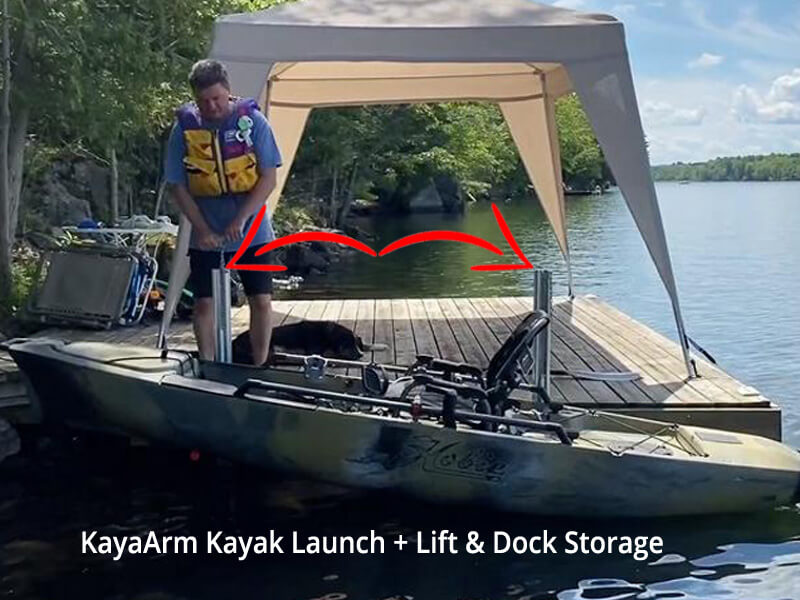
- With the installation of a second KayaArm, you can lift your kayak from the water and store it dockside. To lift and store your kayak, simply pull the chains within the KayaArm masts until the stabilizer arms are supporting your kayak at the desired height. If your kayak is not self-draining, you can easily flip it over to prevent rainwater from accumulating. Leaving your kayak on the raised stabilizer arms keeps your dock free of clutter.
- You can easily remove a stabilizing arm by lifting it through the top of its mast, freeing up space for swimming or boat docking. For convenience, the arm is tethered by a chain to the mast.
- The tide pully option allows the paddler to raise or lower the stabilizing arm to accommodate changes in water level that occur while out kayaking. This feature can be accessed from the dock or kayak.
The KayaArm has an elegant, minimalist design and is the only approved kayak launch for a number of marinas and homeowner associations (HOAs). It can be added to luxury waterfront homes without detracting from the property value.
The KayaArm is sold by Wirsig Enterprises, a family-owned business that maintains a high level of oversight over the entire operation – from manufacturing to personalized order fulfillment and customer service. The KayaArm is manufactured in Canada at a machine shop that specializes in equipment for the food and pharmaceutical industries.
You can purchase the KayaArm online at KayaArm.com. It currently sells for $339 – the lowest cost among mainstream systems and cheaper than most DIY designs. The KayaArm comes with a money-back guarantee, excluding shipping charges, and is delivered in North America typically within 1–5 business days. The KayaArm website contains product documentation and demo videos, and one-on-one consultations are available for unique installations.
PROS
- Excellent entry/exit stability at minimal cost
- Works for a variety of dock types and heights
- DIY installation
- Minimal dock space requirement; not bulky
- Accommodates other watercraft such as canoes and stand-up paddleboards
- A second KayaArm allows for the lift and storage of kayaks
- Compatible with fresh water and salt water
- Money-back guarantee, minus shipping charges
- Good educational support and materials
- Styling is acceptable to most HOAs and marinas
- Fast delivery
CONS
- Does not accommodate motorized watercraft such as Sea-Doos
- To prevent ice damage, it should be removed in winter (depending on the climate)
Kayak Ramp – Stable and familiar
Several companies produce ramp-style kayak launches. This design uses full contact between the kayak and the ramp, which provides excellent stability but requires more upper-body strength during launch and return.
Kayak ramps are typically manufactured from plastic resin and are compatible with both freshwater and saltwater. The ramps are flexible to the tides and will float to accommodate changes in water level.
Since the ramp rests in water, the growth of seaweed can cause a slipping hazard, while barnacles can scratch the kayaks.
Kayak ramps are relatively large and require dedicated space at the side of the dock. Depending on the application, installation can be complicated. It is not practical to temporarily remove the ramp to use this dock space for other purposes.
Kayak ramps are not compatible with fixed docks of any height, and they cannot be used for many types of standup paddleboards due to interference with the fins.
A kayak ramp cannot store a kayak. The paddler must shuttle the kayak between the ramp and the storage location.
Depending on the climate where you live, you may need to remove the ramp from the water to protect it from ice damage. Kayak ramps can also be damaged or lost during hurricanes and major storms.
Some homeowner’s associations will not approve kayak ramps due to their bulkier, heavier build and their appearance.
A kayak ramp launch costs more than a KayaArm but less than a kayak lift.
PROS
- Mid price point; more expensive than a KayaArm but cheaper than a kayak lift
- Good stability
- Compatible with fresh water and salt water
CONS
- Requires upper body strength to pull yourself and your kayak up the ramp
- Marine growth can cause a slipping hazard, and barnacle growth can scrape the kayak
- Not suitable for high fixed docks and seawalls
- Bigger space commitment on the dock
- Overall bulk, weight, and aesthetics
- Recent plastic resin supply issues are affecting cost and delivery times
- Not a DIY installation for many people
- Depending on the climate, winter removal may be required
- No kayak storage capability
Kayak Lifts – Easy to lift your kayak
Kayak lifts are scaled-down versions of boat lifts that were originally designed for yachts. Made from aluminum, the lifts are compatible with both fresh water and saltwater, and they can require routine maintenance. Kayaks can be stored on the lifts.
To install a kayak lift, you need a fixed dock that meets specific requirements for structural support. For this reason, lifts are not compatible with many dock types and typically require professional installation. Once in place, the lift occupies a permanent footprint and, like a kayak ramp, it needs dedicated space on and beside the dock.
The lift height is adjustable from the dock but cannot be adjusted from the kayak to accommodate changes in water level that occur during kayaking.
For stability, the lifts rely on full contact with the kayak hull. Stability is maximum in calm conditions and reduced in choppy conditions.
It is difficult to get a kayak from the dock to the lift without an additional dock extension that includes ropes and rollers.
Kayak lifts are sold and maintained through strong dealer networks, but these networks often prioritize the sales and services related to their larger boat lifts.
Due to the size of the lifts, it may be difficult to obtain approval from your homeowner association or marina.
Kayak lifts are the most expensive solution of all kayak launches on the market and typically cost more than the kayaks they are designed to carry.
PROS
- Works for large drops
- Compatible with fresh water and salt water
- Kayak can be stored on the lift
- Strong dealer network
CONS
- Most expensive of all kayak launches
- Due to support requirements, lifts are incompatible with many dock types
- Large and permanent dock footprint
- Cannot make adjustments from the kayak to accommodate changes in water level that occur during kayaking
- Difficult to get a kayak from the dock to the lift
- Typically requires professional installation
- Blocks waterfront views; can be difficult to obtain HOA and marina approvals
- Requires annual maintenance
Although needs vary, most people are looking for a kayak launch that
- It is simple to use and provides excellent entry/exit stability at minimal cost
- works for a variety of dock types and heights
- Simple DIY installation
- Minimal dock space requirement; not bulky
- Expandable to provide lift and dockside storage of kayaks
- Compatible with fresh water and saltwater
- Money-back guarantee
- Fast delivery
After comparing it with the alternatives, it’s easy to see why the patented KayaArm is the top-selling kayak launch in North America.
Comparison chart by feature
| Feature | KayaArm Kayak Launch | Kayak Ramp (e.g., EZ Dock, YakPort) | Kayak Lift (e.g., Golden’s Kayak Launch) |
|---|---|---|---|
| Typical cost | Lowest cost commercial Kayak Launch. Cheaper than most DIY solutions | More expensive than KayaArm but generally less than a full lift system | Typically the highest cost option of the three |
| Dock space required | Very compact; Minimalist, mounts beside the dock and leaves most of the dock space clear | Long, ramp-like structure that requires significant dock or shoreline space | Bulky cradle and frame that occupy dock edge or pilings |
| Stability at launch | Provides strong lateral support while you stand and sit in the kayak | Improves alignment but kayak can still rock and move on the ramp surface | Stable when boat is fully in the cradle; less focus on stabilizing step-in/out |
| Stability in waves / chop | Can be configured to provide additional stability in wavy/choppy conditions View Video | Stability is reduced in wavy/choppy conditions | Stability is reduced in wavy/choppy conditions |
| Dock height range | “Out of the box” 0-42″ from top of dock to top of water with up to 72″ possible with alternate configurations | Best where a gradual slope from dock to water is possible | Requires enough height and structure for the lift travel and frame, 4′ is typical with models with up to 72″ possible |
| Water level / tide handling | Can be configured for tidal locations with an adjustable tide pulley | Floats with changing water levels when attached to a floating dock system | Many designs are not adjustable from the kayak on return if water level changed while paddling |
| Installation | Screws to dock or seawall; generally DIY-friendly with basic tools | May require framing, anchoring, and more extensive setup | Specific framing and anchoring requirements. Often benefits from or requires professional installation |
| Physical effort required | Minimal lifting; kayak stays in the water and is stabilized beside the dock | May require pushing or pulling the kayak up or down the ramp | Winch or lift operation reduces lifting but hardware still must be operated each time |
| Best suited users | Seniors, solo paddlers, and anyone looking for a stable launch for their Kayak, SUP or Canoes at an affordable price requiring minimal dock space. Paddlers looking to minimize kayak “wrestling” with added dockside storage. | General public recreational use where space and budget allow a ramp | Heavier kayaks in situations where top of dock to top of water is greater than 42″ when space and budget allow. |
| Versatility (craft & tidal use) | Canoes: yes; Kayaks: yes; SUPs: yes; Tidal waters: yes (with appropriate configuration, e.g., tide pulley) | Kayaks: yes; SUPs: generally no, paddle board fins interfere with many ramp designs; Tidal waters: yes, ramp and dock system float with tide | Kayaks: yes; SUPs: often problematic, fins can interfere with many cradle or bunk designs; Tidal waters: not adjustable from the kayak upon return to match changes in water level while paddling |
FAQ: What is the best dock kayak launch for seniors?
A: Seniors generally need a launch that keeps the kayak steady beside the dock, uses little dock space, and does not require heavy lifting of their kayak. KayaArm’s minimalist patented V‑shaped arm stabilizes the kayak beside the dock so seniors can step into and out of their kayak without tipping over and with less fear of falling, and many upgrade to the hoist/storage option so their kayak is always ready to go. Kayak ramps and lifts can work, but they are bulkier, often need more upper‑body effort, and usually take more dock space than many seniors want to give up.
FAQ: How does a kayak launch like KayaArm improve stability when getting in and out?
A: KayaArm holds the kayak stable using its patented V shape arm at water level height, allowing the paddler to literally step in/out of their kayak and sit down from a standing position without tipping, which is especially helpful for paddlers with balance or mobility issues. With the tide pulley option, you can also raise or lower the arm while sitting in your kayak to the correct height for stabilizing your kayak, which is especially helpful if the water level changes while you are out paddling, for example, paddling from a fixed dock in a tidal location.
FAQ: Which launch would work on my type of dock (floating, fixed, seawall, high dock)?
A: KayaArm can be mounted on any dock type, including fixed-height piers, seawalls, floating docks, and high docks, in most cases using the mounting bracket that comes with the KayaArm, as shown in the installation guides and videos. Ramp and lift systems are more restrictive: they often need specific framing, clear shoreline space, or strong pilings, so they may not work – or may be overkill – on small, high, or light-duty docks.
FAQ: Which can be used safely in tidal waters?
A: KayaArm is designed for both fresh and tidal water, and the optional tide pulley lets paddlers adjust the arm height from the kayak when the water level has changed during their trip. Many ramp systems work with floating docks that rise and fall with the tide, while most lift systems are fixed to pilings and do not adjust easily from the kayak, making re-entry trickier when the tide has changed during their trip.
FAQ: Which of them can lift and store my kayak at the dock?
A: KayaArm can both stabilize and lift a kayak: using two arms spaced along the dock, you can hoist the boat out of the water and store it in place directly on the two KayaArms. Full kayak lift systems also hold the boat out of the water but use larger mechanical cradles, whereas most ramp-only launches are not intended to be used for long-term storage and still leave the hull in the water or on a wet, algae-prone surface.
FAQ: How difficult is it to install each of the three kayak launches?
A: KayaArm is a DIY-friendly system that most owners install themselves with 4 wood screws and basic tools by following the printed instructions and how‑to videos. Ramp and lift systems usually involve more parts, framing, or anchoring, and often require professional installation or at least more time, tools, and dock modifications than many homeowners are comfortable doing on their own.
FAQ: Which of the three would be most suitable for people with bad knees, hips, or limited mobility?
A: Paddlers with bad knees, hips, or balance issues typically do best with a launch that stabilizes the kayak right beside the dock at a comfortable height, so they can literally step into and sit down from a standing position in their kayak without crouching onto an unstable boat. KayaArm is designed for exactly this scenario and has been used successfully by seniors and people after joint surgery, while ramps and lifts can still require more pushing, pulling, or climbing than many find comfortable.
FAQ: What is the difference between a kayak ramp, a kayak lift, and KayaArm?
A: A kayak ramp is a long, sloped structure that lets you slide the kayak in and out of the water, but takes up more space and often needs more upper‑body effort. A kayak lift is a bulkier cradle or frame that hoists the boat fully out of the water for storage. KayaArm is a compact, dock‑mounted arm that focuses on stabilizing the kayak at water level height for easy entry/exit and, with a second arm, can also lift and store the kayak without the size and complexity of a full ramp or lift.

About the Author
Jay Wirsig is a Registered Professional Engineer. He is the Chief Executive Officer and Chief Technical Officer at KayaArm. Jay graduated from Queen’s University with a degree in Mechanical Engineering and has over 36 years of experience specializing in the commercialization of new technology. He started designing and building dock structures to withstand Canadian winters and lake ice with his father for their family campground in Westport, Ontario, Canada, at an early age. Jay’s father, Ralph, is the inventor of the KayaArm, designing it initially for his wife, Kathy, so they could enjoy their ritual evening kayaking sessions, keeping track of their fostered loon chicks hatched on a loon nest platform Ralph constructed on Buck Lake. Ralph and Jay collaborated during the initial stages of commercialization of the KayaArm up until his sudden death in 2018, when Jay & his wife Margo (KayaArm COO) purchased the business from his mother Kathy. As CTO at KayaArm, Jay collaborates with his customers experiencing reduced mobility to improve Kayak & Paddleboard launch safety and ergonomics, adapting the KayaArm to all dock types and producing an expert, informative DIY video series for his customers.